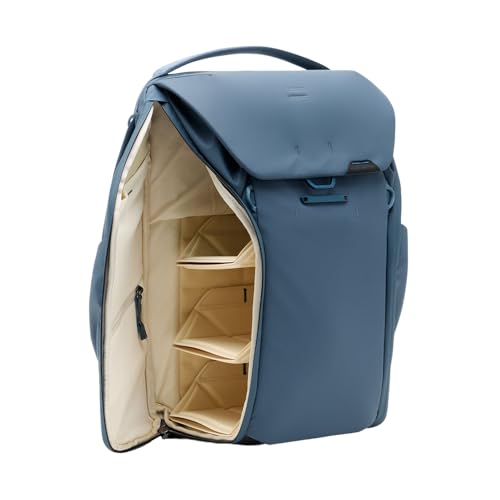
The most consequential difference between these Peak Design travel backpacks may be the opening you use, not the liters you gain. The 30L centers on a large rear hatch. The 45L adds a broader set of access routes. That matters if you need equipment during the day rather than only when the bag is laid open at your accommodation.
What the smaller version gives up and keeps
Peak Design describes the 30L as a more compact travel and daily-carry option, with a large rear opening and a subdivided top pocket. Its stated capacity changes from 27L compressed to 33L expanded. This helps explain why a retailer may use more than one number while referring to the same nominal 30L bag.
The smaller model also has padded laptop and tablet sleeves and accommodates an optional hipbelt accessory. Check whether the package you are viewing includes the accessory. A photograph of a fully equipped setup does not mean every component comes with the backpack.
Why the 45L can suit equipment access
The 45L product description lists top, side, front and rear access. Multiple openings can be useful when your gear has a planned location and you want to reach it without exposing the clothing compartment. They are less useful if objects shift around and the opening leads to a pile of loose belongings.
This is where the camera-cube system deserves a careful look. Match the exact cube size and generation to the backpack, then allow room for clothes and everyday essentials. A camera insert that technically fits can still leave you with too little practical travel space.
Compare two versions of your trip
For the first scenario, assume a laptop, charger, a compact clothing rotation and no camera equipment. Ask whether the larger bag's access options solve anything you regularly encounter. The 30L may handle this job without giving you a large amount of spare space to fill.
For the second scenario, add the camera body, lenses or other equipment that actually travel with you. Keep cases and protective inserts in the calculation. A bare camera sitting on a table is not the same size as a camera packed safely for a moving bag.
Both scenarios should include the empty bag and accessory weight. If an airline limits total cabin mass, elaborate organization consumes part of the allowance before you add clothing. Do not select a bigger backpack merely to make a heavy equipment load look less crowded.
Expansion is a packing option, not airline permission
Use the dimensions corresponding to the bag's intended state in the airline checker. The manufacturer's travel positioning cannot override a specific ticket's allowance. A backpack that fits while compressed may not remain within the same limit after you expand it for the return journey.
Look at external attachment plans too. Strapping a tripod or jacket outside changes the effective outline and can affect stowing, even though the stated internal capacity has not changed.
The sensible split
Choose the 30L when a smaller travel load and straightforward rear access meet your needs. Give the 45L priority when its access routes and larger equipment layout have specific jobs to perform.
If you cannot identify those jobs, start with the compact option or a simpler travel pack. The best modular system is the one whose modules you need, not the one with the most components available.