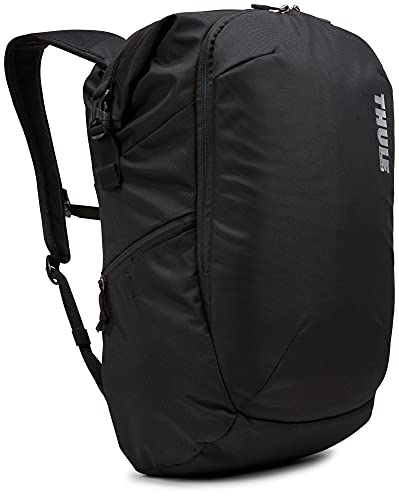
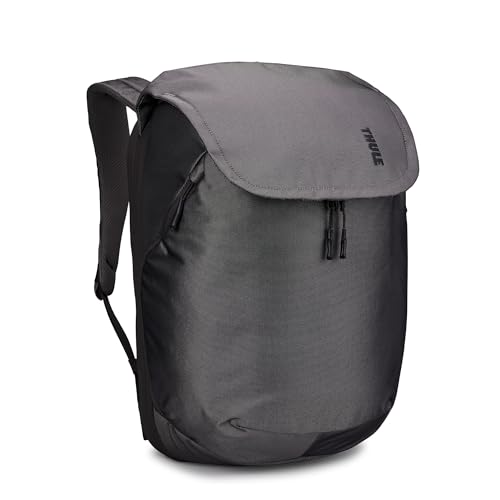
A bargain-priced Subterra is not necessarily a discounted version of the Subterra 2 you were researching. The collection name appears on different capacities and different types of luggage. Before deciding whether an older bag is good value, establish which two products are actually on the screen.
Make a three-line identity card
Record the full product name, capacity and Thule model number. This small step resolves much of the confusion. A backpack, an expandable travel backpack and a convertible carry-on can all carry Subterra branding while organizing their contents differently.
The current official range includes Subterra 2 backpacks at 21 and 27 liters, an expandable travel model labeled 26 liters and a 40-liter convertible carry-on. Older Subterra listings include other capacities, such as the 34-liter backpack. Those are not four simple size options for one unchanged design.
Compare an access route you use every day
Choose one routine: taking out your computer without disturbing clothes, reaching a charger during a flight or opening the main compartment on a luggage stand. Then inspect how each candidate handles that routine. A different zipper path or pocket position can matter more than an updated silhouette.
For example, Thule's Subterra 25L page describes access to laptop and tablet storage from the top or a side zipper. The Subterra 2 21L information emphasizes an internal organization panel and dedicated power-brick storage. These are specific arrangements to examine, not proof that every old bag has side access or every new bag has the same pockets.
Give the newer feature a reason to exist
An additional pocket earns its place if it replaces a pouch or solves an access problem. If your equipment already lives in a removable organizer, extra built-in subdivisions may be less valuable. Conversely, dedicated storage can be useful when you repeatedly misplace small essentials inside a larger compartment.
Apply the same reasoning to expansion. A traveler who alternates between office use and overnight trips may use it frequently. Someone carrying the same daily load might prefer a fixed shape. Do not buy expansion on the assumption that it will make the bag comply with every airline limit in every state.
An older design can still be the right purchase
Age alone does not make a backpack unsuitable. An older version with the opening, capacity and laptop fit you prefer can be a sensible choice. Check that the listing represents new or used stock accurately and that the product photographs correspond to the stated model.
Look carefully at support and returns. A low price is less attractive if the seller cannot explain the version or if an uncertain laptop fit is difficult to resolve after delivery. Avoid using reviews of the current model as evidence about an older bag's durability or layout.
The comparison that produces a useful answer
Write the actual pair at the top of your shortlist: for instance, an older Subterra 34L against a particular Subterra 2 travel bag. Under each, list the device dimensions, packing access and carrying modes that affect you.
That comparison may reveal that the current equivalent is not the bag you first selected. Follow the job you need the backpack to do, and let the generation number become one piece of context rather than the decision itself.