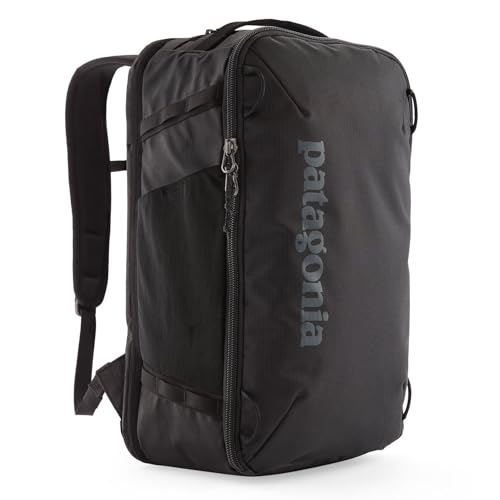
Multiplying a backpack’s height, width and depth gives the volume of an imaginary rectangular box around it. That can be useful, but it does not measure the space available inside. Rounded corners, padding and empty gaps make the difference especially important in compact travel bags.
Label the calculation honestly
With measurements in centimeters, multiply the three dimensions and divide by 1,000 to convert cubic centimeters into liters. A rectangular box measuring 40 × 30 × 20 centimeters has a volume of 24 liters.
A backpack within that exterior envelope will not necessarily hold 24 liters of belongings. Its walls occupy space, and the cavity may taper. Call the result an exterior box-volume estimate. Publishing it as measured usable capacity would imply accuracy that the method cannot provide.
Skip destructive measuring shortcuts
An ordinary backpack is not a measuring vessel. Pouring water into it can soak padding or damage finishes while revealing little about how clothes and electronics will pack. Even a liner introduces its own shape and measurement problems.
For a travel purchase, a repeatable packing comparison is usually more useful than an improvised capacity experiment. The goal is to establish whether the bag accommodates your load, not to replace the manufacturer’s specification with an unsupported number.
Create one fixed test load
Gather the same clothing bundle, toiletry pouch, charger pouch, laptop or book substitute and footwear for each comparison. Keep those objects unchanged between attempts. If using packing cubes, record their packed dimensions rather than relying on names such as medium.
Pack without crushing objects or forcing the zipper. Note which belongings move into exterior pockets and whether that changes the overall outline. A bag may technically contain everything while becoming awkward to access or too bulky for your flight allowance.
Measure usefulness as well as containment
Remove something you expect to need during the journey, then put it back. Can the liquid pouch come out without disturbing the clothes? Does the laptop slide back into its sleeve when the main compartment is full?
This exercise separates maximum stuffing capacity from useful travel capacity. An open cavity may accept one bulky object but provide little separation. Several structured compartments may organize small belongings beautifully while rejecting that same object.
Keep your observations separate from catalog claims
A manufacturer’s capacity may describe the expanded state or a system that includes a detachable accessory. If the method is unclear, record that uncertainty. Do not subtract guessed pocket sizes and announce a corrected capacity.
A practical result is more direct: the required load fits, the laptop remains accessible, the packed dimensions stay within the intended allowance, and some flexibility remains for repacking. Those observations can guide a purchase without arguing whether a backpack holds 23 or 25 liters.
Repeat the comparison when you change a bulky item. New shoes or a thicker protective sleeve can alter the result more than several shirts. Capacity becomes meaningful when connected to the objects you actually intend to carry, rather than treated as an isolated quality score.