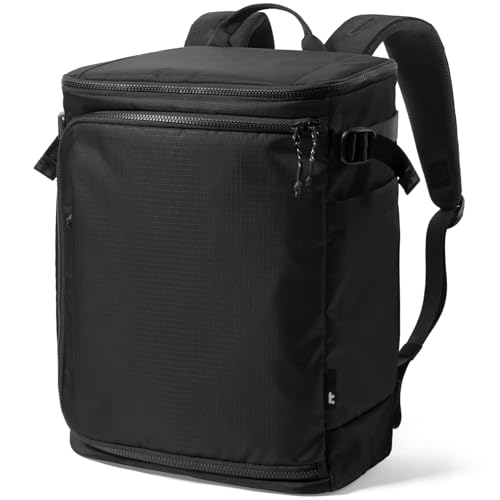
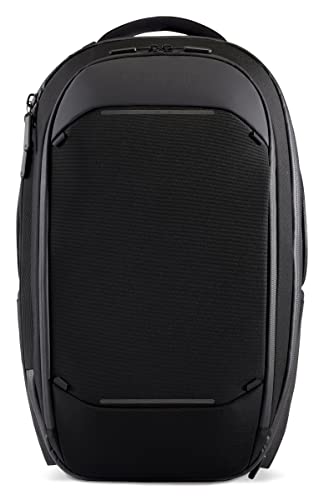
Measure the backpack you are taking on the journey, not the flat bag you pulled out of its packaging. Clothing pushes soft panels outward, a laptop can stiffen the back, and an exterior bottle pocket may change the width. The finished load is the useful starting point.
Prepare the version you intend to carry
Pack the actual or a realistic equivalent of your trip load, including the computer, shoes and other firm objects. Close every compartment and set any expansion panel as you plan to use it. Adjust compression straps normally; do not force the contents into a temporary shape you cannot maintain during travel.
Include the things that will be in exterior pockets. If your plan is to remove a bottle or outer layer before a size check, make sure you have an allowed place for it and that the resulting arrangement remains workable. Loose items are not automatically outside a carrier's baggage rules.
Find the widest points
Stand the bag in a stable position and identify its greatest height, width and depth. A tape pulled tightly around a curved bag measures a path along the fabric, which is different from the straight-line distance between its outermost points. Straight edges or a wall and a flat board can help you identify that outside envelope.
Measure height from the bottom to the highest part included under the applicable rule. Measure width across the widest point and depth from the back to the furthest front projection. Check the carrier's wording for handles, straps and other protrusions instead of assuming a universal measuring convention.
- Record the units beside each number.
- Check a swollen front pocket as well as the main compartment.
- Do not omit a rigid frame or base that cannot be compressed.
- Take a second set of measurements if the bag can expand.
Write down what the measurement means
A useful record might read: packed, expansion closed, bottle removed, straps secured. This context matters more than a bare set of numbers. If you later add a jacket to the front pocket, your earlier depth measurement may no longer describe the bag.
Store the date and the airline allowance you compared it with, using the official policy for your ticket and route. Airline rules may change, and a published size limit is not the same as every individual seat's available space. A measurement can establish a dimensional comparison without guaranteeing a particular boarding outcome.
When the result is close
Repeat the measurement if you are close to a limit, and leave practical room for changes during the trip. A soft bag that fits only after sustained pressure may expand again as soon as it is released. Internal frames, laptop sleeves and hard contents can also prevent compression even when the surrounding fabric feels flexible.
Try removing an optional bulky item before assuming that different folding will solve the problem. If the rigid structure itself exceeds the applicable dimensions, packing less may not make it suitable. Choose a bag whose intended loaded configuration works with your itinerary, and keep the source of any dimension claim clear when comparing products.