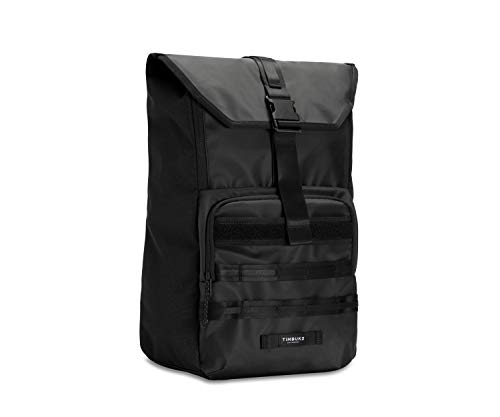
A bag designed to resist rain is not necessarily designed to survive any washing method. Cleaning introduces different conditions, including detergents, rubbing and prolonged wetting. Read the care instructions separately from the waterproof claim before you begin.
Identify the construction and the cleaning rule
Find the exact product's material and care information. Note whether it uses coated woven fabric, a laminate or another specified construction, and whether its seams and closure have special instructions. Do not substitute a routine for an unrelated dry bag merely because both products roll closed.
Remove the contents and any detachable components as directed. Pay particular attention to organizers, padded inserts and electronics. If a support panel is not documented as removable, leave it in place and ask the maker how the bag should be cleaned.
Inspect the protection-critical areas first
Check the roll-top edge, closure hardware, seams and interior surface. Record obvious damage before cleaning so you do not mistake an existing problem for a new one. A peeling layer or damaged closure needs an assessment, not an assumption that washing will restore it.
Use the manufacturer's approved cleaning method and tools. Avoid aggressive brushing, solvents or heat unless the instructions explicitly permit them. Do not soak a product that is meant to be wiped or spot cleaned.
If grit is caught around a closure, remove it gently through the approved process. Forcing a zipper or scraping a coated fold can create a second problem while you are trying to solve the first.
Let the inside finish drying
Follow the maker's drying directions and allow air to reach the interior where the design permits. A dry-looking exterior does not establish that folded material or padding is ready for storage. Leave time for the whole bag rather than packing it away on a fixed clock.
TOM BIHN's coating discussion emphasizes drying the inside after wet exposure. That is a useful maintenance principle to check against your own bag's instructions, especially when storage follows immediately after a trip.
Do not add waterproofing spray as an automatic final step. A treatment appropriate for one surface may be unnecessary or unsuitable for another. Ask whether the bag requires it and which product, if any, is approved.
Recheck the closure before the next journey
Practice the documented closing sequence with your normal load. Make sure no organizer, lining or excess contents obstructs the required fold or roll. The Arcane Roll Top WP manual from Osprey is an example of a bag whose claimed protection depends on a specific closure configuration.
Cleaning does not increase the original protection rating. If you notice damage or have doubts about the seal, consult the maker before carrying sensitive equipment in wet conditions. Use any recommended checking procedure without valuables inside.
Store the bag dry and in the condition its care instructions specify. Good maintenance supports the design you bought; it does not turn a splash-resistant travel pack into an immersion-proof container.