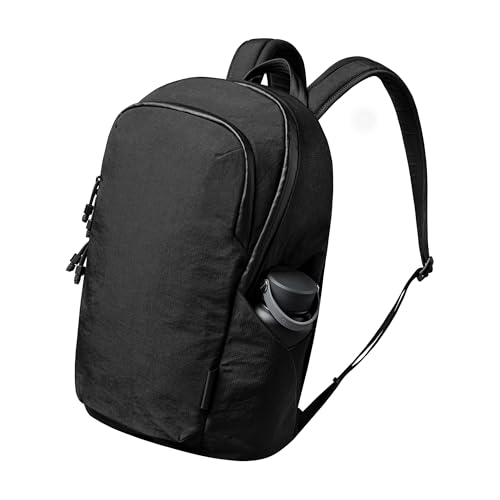
Decide where the backpack belongs before you reach your row. If it is your personal item, the airline may require it beneath the seat. If it is your main carry-on, it will usually use the permitted cabin storage for that category. Crew instructions take priority over your preferred arrangement.
Prepare the few things you will use
Before boarding, gather your headphones, glasses, reading material and other immediate essentials into one reachable part of the bag. That saves you from reopening a large pack while other passengers are trying to pass.
Keep the group within your allowed luggage arrangement. A small pouch can be useful, but an extra pouch carried separately is still an object you must manage. Return it to the backpack when moving through the terminal.
Underseat storage needs a tidy outline
Loose straps can extend into the footwell even when the main body fits. Tuck away dangling webbing and close pockets before placing the bag. Do not leave a bottle or accessory half attached where it can roll or catch.
Position the bag as directed so it fits securely without intruding into another passenger’s space. If a support or installed component prevents a sensible fit, ask the crew rather than forcing the backpack against equipment or assuming another location is permitted.
Overhead access is not an unlimited resource
If the backpack belongs overhead, lift and place it carefully. Avoid swinging a heavy pack past seated passengers. A top handle can make the movement easier, but it should be used within the bag’s intended carrying design.
Do not assume the bin directly above your seat will be empty. Keep valuables and journey essentials accessible in a way consistent with the airline’s instructions. If the bag must be checked because cabin storage is full, use your prepared removal plan.
Different seats can require different handling
An unusual seat arrangement may change where belongings can remain during parts of the flight. Follow the crew’s directions rather than applying a rule learned from another aircraft. Storage requirements are not something a backpack manufacturer can guarantee.
Lufthansa’s official guidance distinguishes larger items in overhead storage from personal belongings beneath the seat. Delta also emphasizes avoiding blocked footwells and trip hazards. Those principles explain why an apparently convenient position can still be unsuitable.
Choose access features around the flight
A full clamshell opening can be excellent in a hotel room and inconvenient beside your feet. For in-flight use, a reachable top or front compartment may matter more. Check whether that pocket remains accessible when the bag is lying in its likely stowed orientation.
Avoid packing all useful items against the far end of the main cavity. Try the arrangement while seated at home: retrieve one item, replace it and close the bag without spreading everything around you.
The aim is a backpack that becomes unobtrusive once stowed. A slightly smaller, well-organized personal item can make a long flight more comfortable than a larger one packed to its limit, even when both satisfy the published allowance.