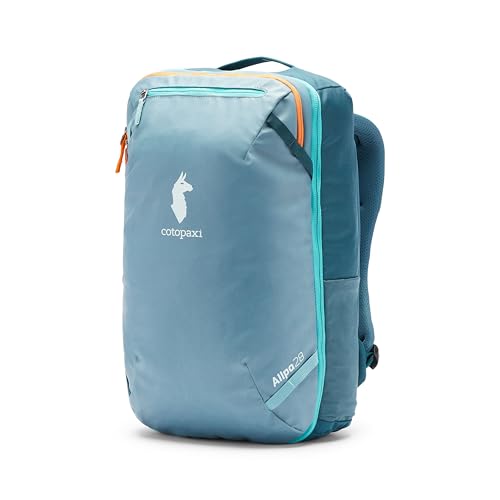
The Allpa 35 offers seven more nominal liters than the 28—a 25% capacity increase—but the better choice also depends on the carrying system and the version on sale. Both linked Blue Spruce and Abyss listings describe divided, suitcase-style packing. Moving up to the 35 does not mean changing to one uninterrupted compartment.
What the linked bags have in common
The 28L listing specifies three internal compartments, a stretch bottle pocket, a rear luggage pass-through and a padded 15-inch laptop sleeve. The 35L listing describes those same basic features. There is therefore no documented laptop-size upgrade in this pair merely because the bag is larger.
Check your computer first if it is the item you cannot substitute. Then assess your packing cubes against the internal divisions. One long organizer may fit poorly even when the total nominal capacity sounds sufficient.
What the extra seven liters should do
Choose the 28 when your normal clothes and equipment fit without a second loose bag or a tightly choreographed closing routine. Choose the 35 when you can identify the object that requires its extra room: shoes, an additional work outfit or a bulkier weather layer. These are packing scenarios, not tested load capacities.
Keep the same belongings in both trials. If the 35 immediately acquires extra clothing simply because there is space, you have changed the test. Conversely, the smaller bag is not a useful saving if its contents make every pocket difficult to open.
Compare the belts, not only the liters
The 28L listing describes a tuckable waist belt. The 35L description specifically presents its hip belt as part of a weight-transfer system and says its shoulder straps can be tucked away. This makes a loaded harness comparison worthwhile if you expect long walks; the listing language alone cannot establish which bag fits you better.
Try lifting each loaded pack as well as walking with it. The larger bag’s capacity is useful only if you can handle the finished load through stairs, train doors and overhead storage.
A specification pair that shows why versions matter
For the TPU-coated configurations documented by Cotopaxi Europe, the 28L is listed at 48 × 30 × 23 cm and 1,190 g; the 35L at 56 × 30 × 25 cm and 1,605 g. In that specific pair, the 35 is 8 cm taller, 2 cm deeper and 415 g heavier. The width is the same.
Those European pages describe four-handle configurations, while the linked Blue Spruce and Abyss offers describe a redesigned three-handle layout with a bottle pocket and luggage pass-through. Do not assign the European dimensions or weights to those offers without matching the edition. Compare the seller’s photos, exterior measurements and carrying features together.
Use the flight allowance as the final filter
Neither Allpa size guarantees personal-item acceptance. Compare the selected version’s packed height, width and depth with every carrier and fare on the itinerary. A smaller capacity can still exceed a strict underseat limit, and a larger bag that fits the sizer can still exceed a weight allowance.
The practical decision is the smallest of these two that holds your fixed load, fits your body and satisfies your route. If either dimension or version remains unresolved, settle that detail before choosing a color or treating a sale price as the deciding factor.