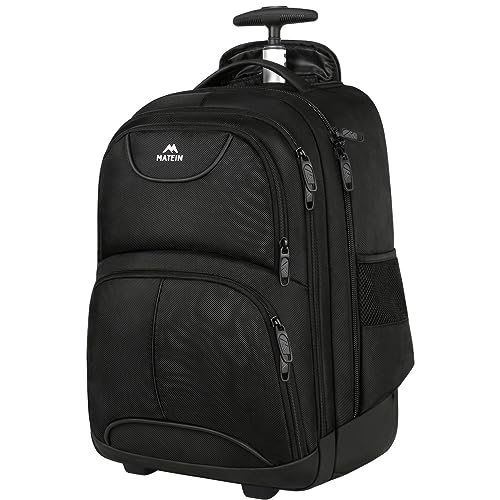
Wheels can save your shoulders in a long terminal, but their hardware takes up space and adds weight. On an underseat backpack, those costs are especially visible. Compare the whole travel routine before choosing a hybrid simply because it offers two carrying modes.
Start with the wheel-to-handle outline
The relevant outside dimensions include the parts the airline counts, such as wheels and handles. A compact fabric compartment sitting above a wheel housing may have a larger overall height than it first appears.
Look for a clearly labeled full-product measurement. A listing describing only the main body can leave the most important protrusions unresolved. Check whether the handle retracts completely and whether any base support extends beyond the bag.
The mechanism also uses interior or structural space. A rolling bag and an ordinary backpack with similar outside dimensions may offer different usable cavities. Compare the objects you need to pack rather than assuming equal capacity from a similar silhouette.
Decide where each carrying mode will be used
Rolling is helpful on suitable smooth surfaces. Stairs, rough paths and crowded transfers may require lifting or wearing the bag. Estimate how often those situations occur on your actual route.
Try the shoulder straps with the wheels and handle assembly still part of the load. A hybrid can feel different from a purpose-built backpack because the rigid hardware remains against the bag’s structure. A conversion feature is useful only if you can tolerate the converted mode.
Also consider lifting into storage or a vehicle. The top handle and overall packed weight matter even when the bag spends much of the journey on wheels. Avoid treating rolling capability as a reason to pack beyond what you can manage.
Keep the underseat requirement separate
A wheeled backpack does not gain an exception to personal-item dimensions because its wheels fold or its straps tuck away. Compare the configuration that will actually enter the cabin. If a dimension depends on removing a component, understand where that component will travel.
Actual underseat space can also vary. A rigid wheel base is less adaptable around an obstruction than a soft clothing compartment. A numerical allowance check therefore should not become a guarantee for every seat.
Think about access when the bag lies down. A pocket convenient while rolling upright may face away from you beneath the seat. Keep immediate essentials in a location that works in both orientations.
Choose the compromise consciously
A rolling underseat backpack can suit someone who values rolling through terminals but still needs occasional shoulder carrying. A standard backpack may be simpler when walking dominates. A small wheeled case may be preferable when backpack mode would rarely be used.
Compare exact models for total size, empty weight, handle operation and strap storage. Inspect the selected variant on Amazon, then test the loaded bag before travel. The strongest choice makes the frequent part of your journey easier without making the occasional stairs or lifting task unmanageable.