The best international carry-on backpack is the smallest documented bag that clears every booked segment and still holds your fixed items. There is no universal international size: a regional connection, low-cost fare or 7 kg weight limit can be more restrictive than the long-haul flight that defines the trip in your mind.
Build the route matrix before the product shortlist
List each operating carrier, not only the airline that sold the ticket. For every segment, record whether the fare includes a personal item, an overhead bag or both; then add the three outside dimensions and any weight limit. Keep separately booked flights and the return journey visible because their entitlements may differ.
Treat the strictest included allowance as the route constraint unless you plan to buy or check another bag. A codeshare label, loyalty status or allowance on the first flight does not automatically carry over to a different operator. Recheck the booking confirmation after a schedule or aircraft change.
Keep airline figures in their published units. Repeated conversions can blur a boundary, and a soft backpack that is nominally close to a maximum can exceed it once the laptop, handles and front pockets are loaded.
Four current rules show why one international size fails
These rules were checked September 23, 2026 and are comparison anchors, not a promise of boarding acceptance. The exact fare, operating carrier, aircraft and current policy still control the trip.
- Ryanair includes one 40 × 30 × 20 cm small bag. Its Priority & 2 Cabin Bags entitlement adds a 55 × 40 × 20 cm overhead bag with a 10 kg limit.
- easyJet includes one 45 × 36 × 20 cm underseat bag up to 15 kg. Its 56 × 45 × 25 cm large cabin bag requires a booked allowance or qualifying benefit, and you must be able to lift and carry it.
- Lufthansa short- and medium-haul Economy Basic includes only a 40 × 30 × 15 cm personal item. Other listed economy fares add one 55 × 40 × 23 cm overhead bag up to 8 kg; long-haul Economy lists the personal item plus that overhead bag.
- Singapore Airlines Economy and Premium Economy list one cabin piece up to 7 kg with combined length, width and height no greater than 115 cm. A linear total does not prove that an unusually shaped bag will fit a particular bin.
Compare three exact bags in the state you will board
CABINZERO lists the current Classic 28L at 39 × 29.5 × 20 cm and 600 g. Those factory dimensions sit within Ryanair's included small-bag envelope on paper, but depth already reaches the published maximum. First confirm that the selected Amazon version matches the current maker model, then measure the loaded bag without pressing a laptop or other rigid object into shape.
Osprey lists the Daylite Expandable 26+6 at 43 × 33 × 16 cm and 0.84 kg before expansion. Its unexpanded shell fits inside easyJet's included small-bag dimensions on paper. The expansion adds about 6 liters and two inches of depth, which changes the boarding envelope; extra room at the destination is not permission to board expanded.
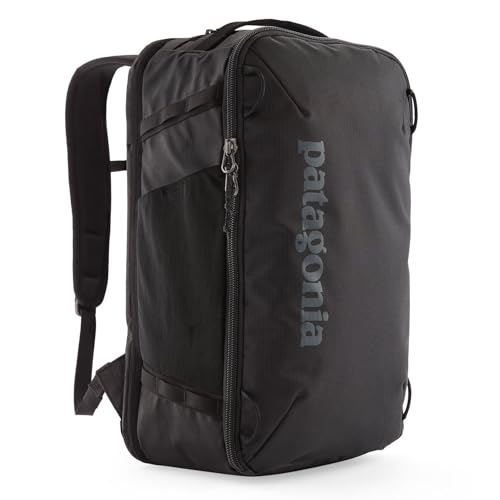
Patagonia lists the Black Hole Mini MLC 30L at 20 × 12 × 7 inches and 1,290 g. That shape fits inside the cited Ryanair Priority and Lufthansa overhead dimensions on paper after unit comparison, but it is too tall for their cited personal-item envelopes. Its empty weight also leaves less of a 7 kg or 8 kg allowance for belongings than either lighter example.
Choose by the binding constraint
- Choose the CABINZERO when the exact seller version matches the documented 39 × 29.5 × 20 cm model and a compact metric envelope controls the route. Leave margin at the 20 cm depth boundary.
- Choose the Osprey when its unexpanded 43 × 33 × 16 cm state matches the booked allowance and you value expansion after arrival. Measure both states and board in the one you checked.
- Choose the Patagonia when the itinerary includes an overhead bag large enough for 20 × 12 × 7 inches and its convertible carry layout matters more than minimizing empty weight.
- Choose none of them when a rigid laptop, medical item or fully packed pocket breaks the controlling size or weight rule. An existing smaller bag can be the better international choice.
Run the itinerary through the checker, then verify the booking
Use the airline fit checker only where it provides a current three-axis envelope for the operator and allowance. Singapore Airlines publishes the cited 115 cm linear total instead, so compare that rule manually rather than expecting the checker to model it. A dimensional pass means only that the numbers fit the stored envelope; it does not add a bag to the fare, confirm a shared weight allowance or guarantee space on a particular aircraft.
Weigh the finished load, including the backpack itself. On a weight-led route, moving a charger or camera to another bag may not help if the airline applies a combined cabin limit. Keep batteries, medication and essential documents in a small removable group in case an overhead bag must be checked.
Repeat the measurement before the purchase return window closes and again for the trip home. Souvenirs, laundry, an expanded zipper and filled exterior pockets can change the exact bag that passed the outbound check.
Sources & further reading
- Ryanair: included small bag and Priority cabin bag
- easyJet: small and large cabin-bag allowances
- Lufthansa: fare- and route-specific cabin baggage
- Singapore Airlines: cabin baggage weight and linear dimensions
- CABINZERO: current Classic Backpack 28L specifications
- Osprey: Daylite Expandable Travel Pack 26+6 specifications
- Patagonia: Black Hole Mini MLC 30L specifications